

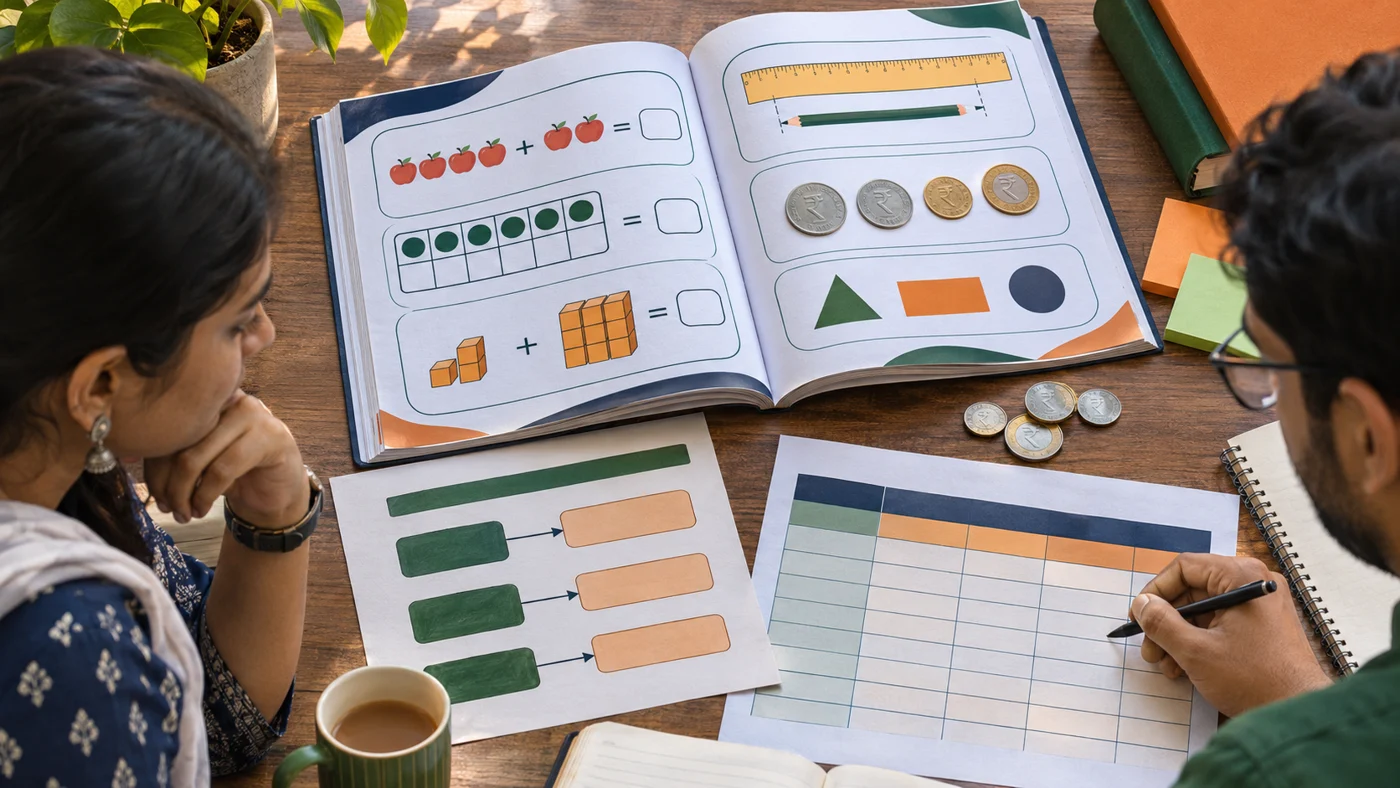
If you’re deciding how to map curriculum for Indian schools, start with the learning outcome and the evidence in the material. Two chapters can both be called Money, yet ask learners to do different things. One may teach students to recognise coin values. Another may expect them to add prices and explain how they reached a total.
A useful mapping exercise shows the publisher where the material fits, where a change is needed and which teaching strengths should be preserved.
1. Content coverage
Choose the curriculum followed by your target schools. Record the learning outcome, then identify the page, task or assessment item that addresses it.
Distinguish between a topic being mentioned and a skill being taught, practised or assessed. A single worked example may introduce a skill, while the target curriculum expects students to apply it independently. Mark the gap at that level so an editor knows what to add.
2. Sequencing
Check when each concept is introduced and what students need to know before they meet it. A chapter may cover the right content but depend on a concept that target schools teach later in the year.
Where that happens, consider moving the lesson, adding a brief prerequisite activity or providing guidance to teachers about when to use it. Record which change solves the problem so the original progression remains coherent.
3. Difficulty
Compare what students actually have to do. Look at number ranges, reading demands, the number of steps, the support provided and whether students are expected to explain their thinking.
An activity may be mathematically appropriate but difficult to access because of dense instructions or unfamiliar vocabulary. That finding calls for different action from a task whose mathematics is too advanced for the target grade.
4. Classroom context
Review the examples, language, units and materials students encounter. Some changes are straightforward, such as adapting currency or measurement conventions. Others need more care. A scenario may need to change while the underlying learning objective and teaching sequence stay intact.
Illustrative Grade 2 mathematics example. Suppose a workbook teaches addition through a shop exercise using dollar prices. If the target learning objective is to add two prices, you could retain the worked example, the number range and the addition strategy. Adapt the activity to use rupees and a familiar shop setting. Check that the new prices preserve the intended difficulty and that the revised instructions still assess addition.
Turn the mapping into an editorial decision
For each finding, record the target learning outcome, the source evidence, the type of gap, the recommended action and what should be retained. Prioritise changes that affect whether students can meet the learning outcome. This gives editors a basis for estimating effort and deciding whether to retain, adapt or redesign a unit.
IndiaEdXpert’s Curriculum Gap Assessment applies these checks chapter by chapter and translates the findings into a mapping workbook and an adaptation plan.